
Builders across Borders: Joe Feghali
On information, trust, and building something that couldn't exist without the in-between.


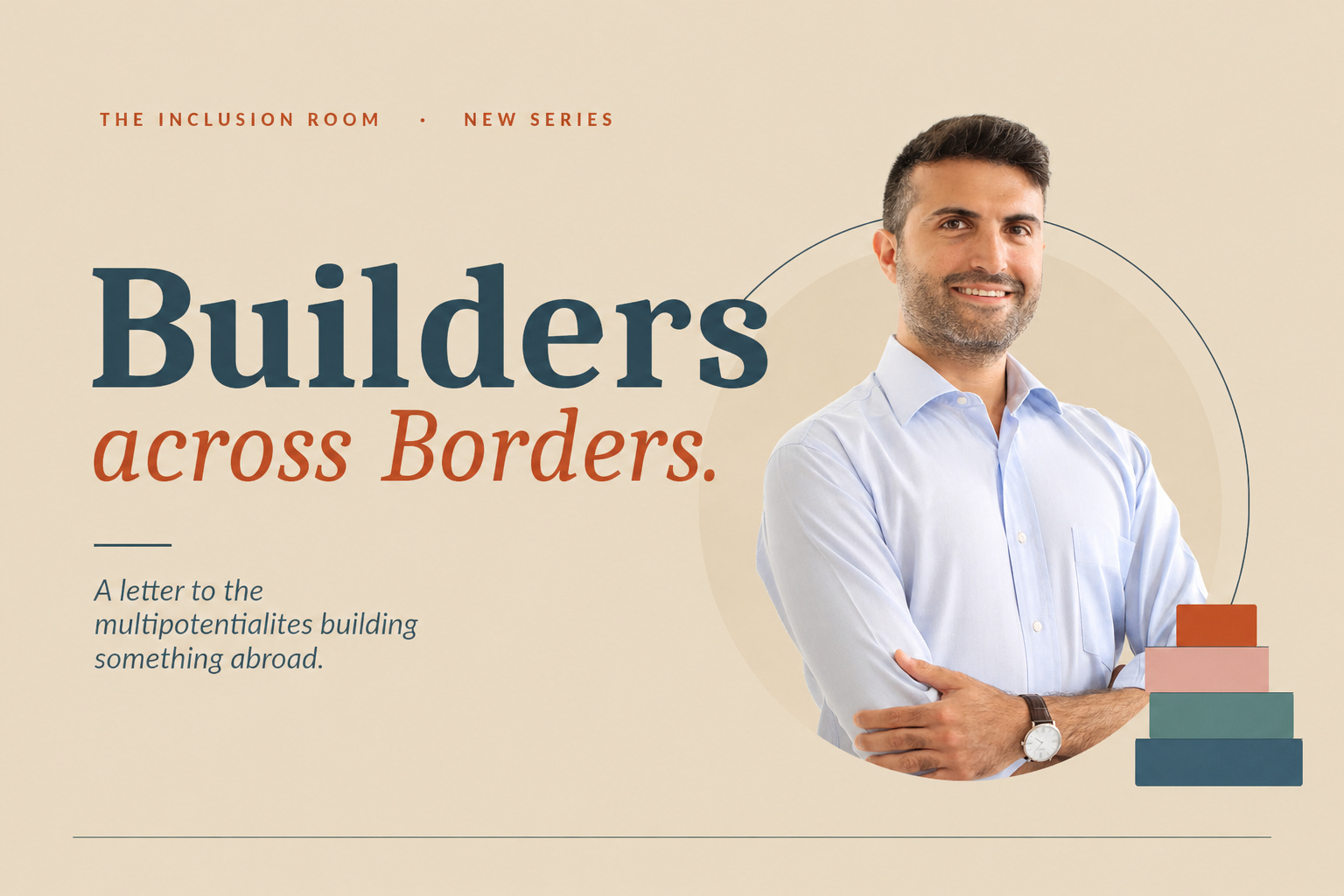
Some people don’t just live between cultures.
They build from there.This is a space for their stories.
Builders Across Borders explores how people build projects, practices, and businesses using their multicultural experience as a lens, not an obstacle to overcome.
1 · Who you are, in your own words 🪞
I am an orthodontist and the founder of LumiQuest Dental Circle, an independent dental guidance platform helping expats, starting with Dubai, make clearer decisions before dental treatment.
Born and raised in Lebanon, with years spent between Lebanon, Canada, Dubai, and now the Balkans.
Someone who knows what it means to rebuild from scratch, more than once, in more than one system.
2· The gap you saw 👀
What did you notice that people rooted in one system didn’t? Which of your intuitions, born from living between cultures, became strategic?
The more I moved between countries, the more I noticed that every system has its own invisible rules. What feels obvious to someone inside a system can feel completely unclear to someone entering it from the outside.
That became very clear to me in healthcare. Today, information is everywhere: Instagram, Google Maps, clinic websites, before-and-after photos, reviews. But information does not automatically create trust. At the same time, trust alone is not enough either. A friend’s recommendation can be helpful, but it does not always mean that clinic, dentist, or treatment approach is the right fit for your specific situation.
The gap I saw was between information and trust. Expats often need both: practical signals that help them compare clinics more intelligently, and a human layer that includes clinical judgment, patient experience, and reputation built over time.
The intuition that became strategic was this: when people enter a new system, they do not just need access to information. They need help interpreting what that information actually means.
I am building LumiQuest around a simple idea: patients abroad need more than information. They need clarity, trust, and someone who understands what it feels like to navigate an unfamiliar healthcare system.
That became one of the foundations of LumiQuest: an online word-of-mouth system with structure behind it, designed to make dental decisions abroad clearer and safer.
3 · The turning point 🔁
Looking back, what made it possible? What was your relationship to risk based on — and do you think you knew it at the time?
Looking back, the turning point was not one dramatic moment. It was the moment the different parts of my life started to connect.
I had practiced dentistry and orthodontics in Lebanon, built my own clinic life, completed a Global MBA at IE Business School while working, then moved to Canada with the hope that my clinical and business background would open new doors. Canada challenged that assumption.
I realized that experience does not always translate easily across borders, and the dental equivalency path made me question whether I wanted to spend years rebuilding inside another system.
That period pushed me to expand beyond the traditional boundaries of dentistry and add technology as a new layer to my work. At the time, these chapters did not always feel connected. Dentistry gave me the clinical lens. Business gave me the strategic lens.
Technology gave me the confidence to think in systems and build online. Living between countries made me more aware of how much context people need when they enter an unfamiliar system.
LumiQuest came from the intersection of those worlds. It was not only a dental idea, a business idea, or a technology idea. It was the result of seeing how all three could work together to solve a very human problem: helping patients make clearer decisions when they do not fully know whom to trust.
My relationship with risk has always been shaped by a simple belief: if I never try, I will never know. I did not have a perfect plan, but I trusted that each attempt would teach me something.
Now I see those chapters as preparation. LumiQuest is where they started to make sense together.
4 · Trust as raw material 🤝
When you build from an in-between position, trust becomes the central ingredient. How do you build it?
I think trust has to come from how LumiQuest works, not just from who is behind it.
Most people who find LumiQuest online do not know me personally, so I cannot expect them to trust the idea only because I am an orthodontist. The question for me was: how can LumiQuest help people feel safer when choosing a dentist abroad?
The first part is independence. Clinics cannot pay to be ranked or promoted. LumiQuest is not built around “top clinic” lists or sponsored placements.
The second part is looking across time, not just at one snapshot. A clinic’s Instagram page can be useful. Google reviews can be useful. A friend’s recommendation can be useful. But each one has limits. LumiQuest looks for repeated patterns across different signals: public feedback, how cases are presented, communication style, patient experience, and consistency over time.
The third part is empowering the patient. Guidance should not only point someone toward a suitable clinic. It should also help them understand what to ask, what to clarify, and what warning signs to notice before committing.
Then there is the feedback loop. If a patient shares their experience privately afterward, LumiQuest can learn from that and refine future guidance.
LumiQuest cannot make dentistry risk-free, and it does not replace the dentist-patient relationship. But it can help patients move forward with more clarity, better questions, and less pressure.
5 · Legitimacy 🗝️
How did you build your legitimacy — both toward yourself and in the eyes of others? What did you have to do, unlearn, or claim?
I think I built legitimacy by doing the work little by little, before I felt completely ready.
At first, I still thought legitimacy had to come from a very clear box: being a dentist in a clinic, holding a license in one country, or having a traditional role people immediately understand. Those things matter, but moving between countries taught me that your experience does not always translate neatly from one system to another.
I had to unlearn the idea that my clinical knowledge only mattered if I was using it chairside. I started to see that it could also help patients before treatment begins: by explaining, guiding, asking better questions, and making confusing decisions feel less overwhelming.
So I began building LumiQuest, writing about dental cost transparency, creating clearer patient guides, and sharing the idea with people and platforms that speak to expats. Each small step made it feel more real. Every article, every page, every thoughtful response, and every “yes, this makes sense” helped build legitimacy from the outside and from the inside.
What I had to claim was the mix itself. Dentistry, business, technology, and living between countries were not separate pieces anymore. Together, they became the reason LumiQuest could exist.
6 · If you had to start again tomorrow 🌱
What would be the most meaningful thing to get right from day one?
If I had to start again tomorrow, I would spend more time listening to patients earlier.
LumiQuest is still young, so I am not answering this as someone who has everything figured out. I am answering as someone still building, testing, and learning. In the beginning, I put a lot of energy into making the structure strong: the website, the guides, the trust framework, and the way the idea should work. That mattered, because healthcare is sensitive, and I did not want to create something shallow or rushed.
But I have learned that a project like this has to stay very close to the people it is trying to help. Real patient questions are often simple on the surface, but underneath them there is usually worry. Am I choosing the right person? Is this price fair? Am I being pressured? What happens if something goes wrong?
If I had to start again, I would still build carefully, but I would listen earlier and more often. The most meaningful thing to get right is not perfection. It is making sure the work stays close to real people, real doubts, and real decisions. That is what makes LumiQuest more useful, more human, and more trustworthy over time.
7 · What’s still unresolved
Even now, after everything you've built — what challenge stays open?
What is still unresolved is how to grow without losing the reason LumiQuest exists.
I am still building, so there are practical questions that remain open: how to reach the right patients, how to keep improving the clinic evaluation process, how to collect useful feedback, and how to make the guidance model stronger over time.
But the deeper challenge is trust at scale. It is one thing to be careful when the circle is small. It is another thing to grow while staying independent, selective, and human.
I want LumiQuest to become stronger as more real patient experiences come in, not more diluted or more commercial.
I do not want LumiQuest to become another directory, another ranking page, or another platform where visibility slowly becomes more important than judgment.
So the unresolved question I keep returning to is:
how do you build something useful enough to grow, but disciplined enough not to become what you were trying to fix?
I do not have the full answer yet. But I think the direction is clear: grow slowly, keep listening to patients, stay honest about limits, and let trust remain the center rather than the marketing layer.
A final note
Joe, thank you. For the generosity with which you answered, and for the precision with which you named what usually stays implicit: the distance between information and trust, the cost of rebuilding legitimacy inside a system that doesn’t recognize you.
The gaze of the outsider who tries to figure things out can lead to creating something meaningful for others.
Are you a builder across borders?
Are you building something — a project, a practice, an idea — while living between cultures? Builders Across Borders is a series in the making, and I need voices. Not already-resolved success stories. Stories from people who are still in the middle, still asking the same questions Joe was asking. If this resonates, reach out. Leave a comment. Or simply reply to this email. Every conversation builds the net.
On my side, I am building something with Maria Cires: a retreat for capable women who know they are meant to build something of their own but have been circling for years. This retreat provide the space, structure, and support to get clear and start.
And speaking of building across borders: Kaila Krayewski created Home Abroad exactly one year ago from Thailand!
One year of words, readers and community across the world. Now she’s hosting a housewarming and she’s opened a Wall to welcome us in. See you there!
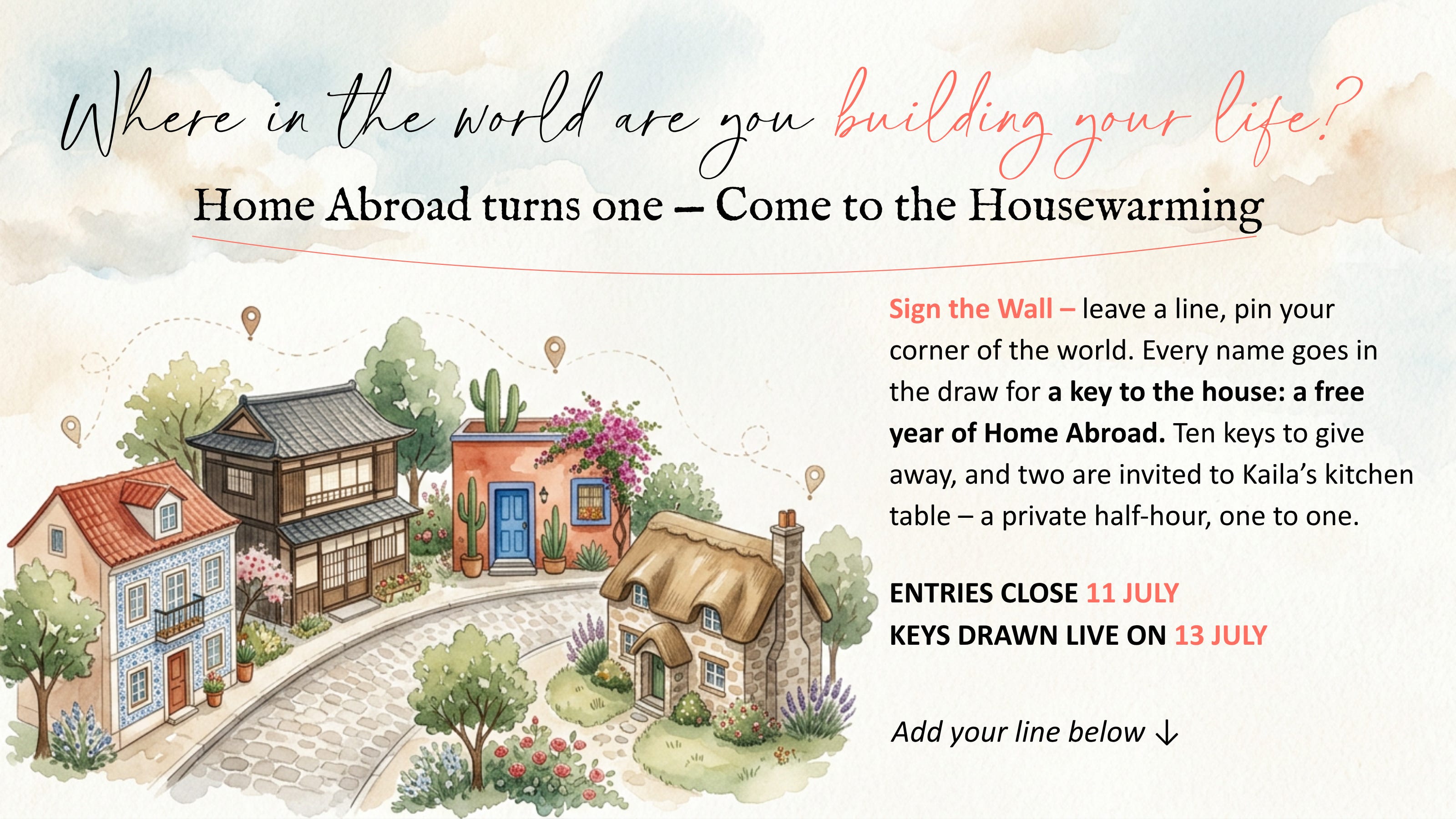
Kaila will also be one of the next guests on Builders Across Borders. Stay tuned!
 | A guest post by
|